

A Complete Guide for Patients & Families
When someone is diagnosed with End-Stage Kidney Disease (ESKD), one of the biggest decisions is choosing the right type of dialysis. This choice affects your medical treatment, lifestyle, independence, comfort, and long-term health.
This guide simplifies all dialysis options—Hemodialysis, Peritoneal Dialysis, Home Hemodialysis, and Nocturnal Dialysis—so you can make an informed decision with your nephrologist.
Hemodialysis (HD)
What It Is
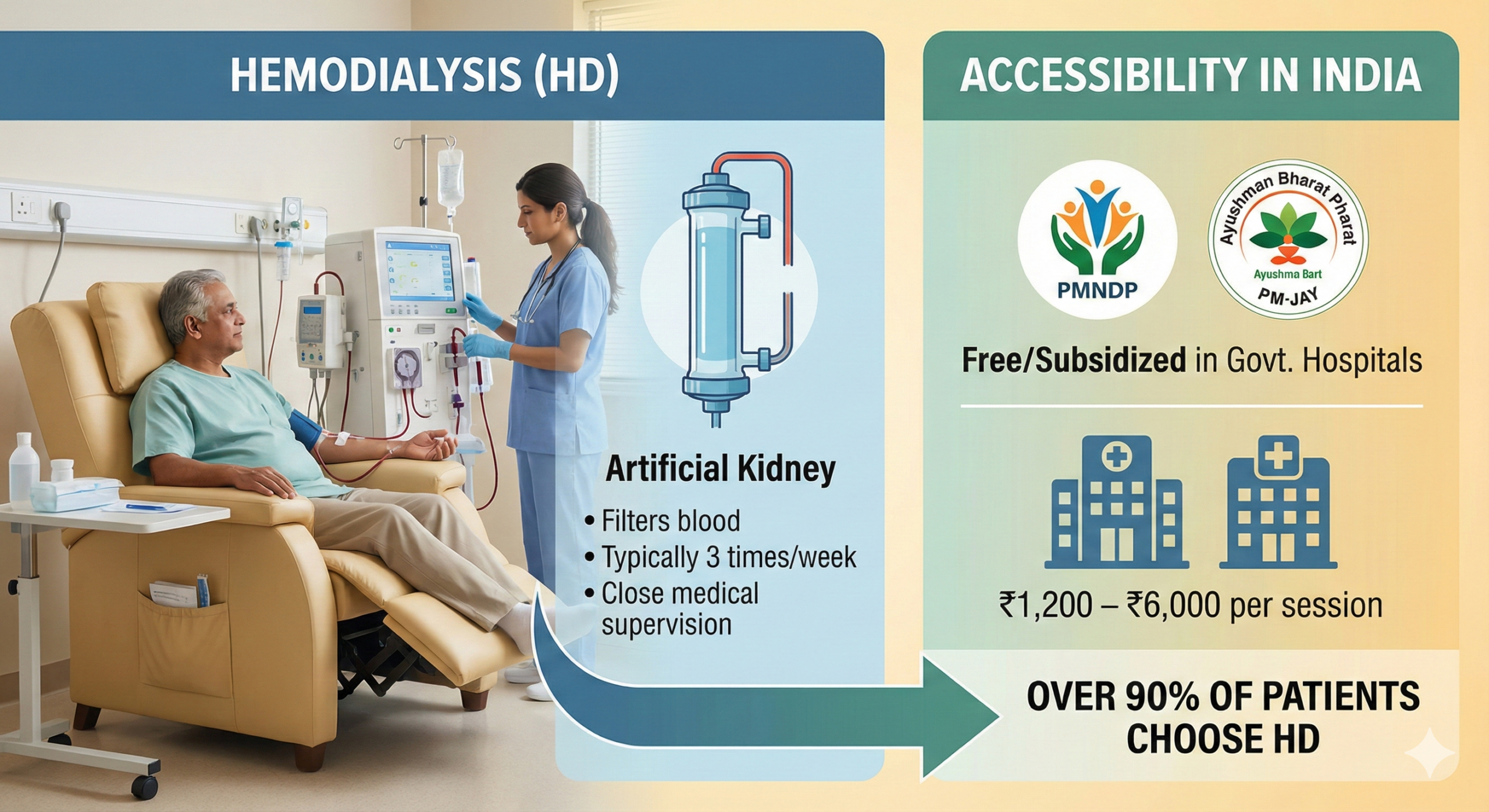
Hemodialysis filters your blood using a dialysis machine and a dialyzer (“artificial kidney”).
Where It Happens
- Dialysis centers
- Hospitals
- Home (for selected patients)
How Often
- Typically 3 times a week,
- 4–5 hours per session
Who Should Choose HD
- ✔ Patients who want close medical supervision
- ✔ Those uncomfortable managing dialysis at home
- ✔ Patients with abdominal issues preventing PD
- ✔ Anyone needing rapid correction of electrolytes or fluid overload
Benefits
- Performed by trained technicians & nurses
- Regular medical monitoring
- Suitable for elderly or high-risk patients
- Effective toxin and fluid removal
Limitations
- Requires travel to a center
- Fixed schedule
- Possible post-dialysis fatigue
Cost & Accessibility in India
Hemodialysis is the most affordable and widely available dialysis modality in India.
- Government hospitals / PMNDP: Free
- Ayushman Bharat (PM-JAY): Coverage in empanelled hospitals
- State schemes:
- Delhi, Rajasthan (BSBY), Tamil Nadu (CMCHIS), Karnataka (Arogya Bhagya), others
- Private hospitals: ₹1,200 – ₹3,000 per session
- Corporate hospitals: ₹3,500 – ₹6,000 per session
➡ Over 90% of Indian dialysis patients choose HD due to strong government support.
Peritoneal Dialysis (PD)
What It Is
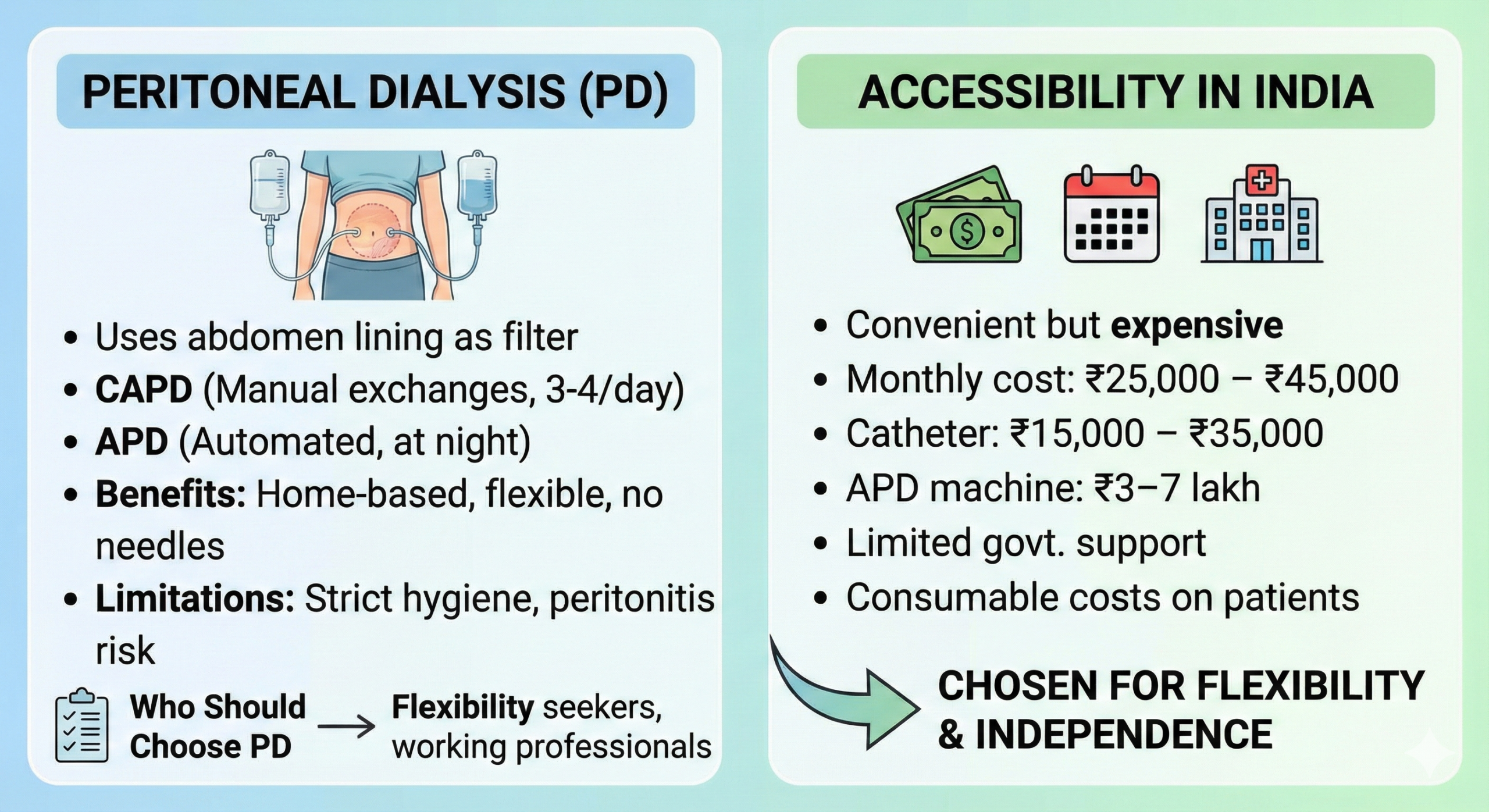
PD uses the lining of your abdomen (peritoneum) as a natural filter.
Types
- CAPD (Continuous Ambulatory Peritoneal Dialysis)
Manual exchanges 3–4 times/day - APD (Automated Peritoneal Dialysis)
Done at night using a machine while you sleep
Who Should Choose PD
- ✔ Patients wanting flexibility & independence
- ✔ Those living far from dialysis centers
- ✔ Working professionals
- ✔ Children & teenagers
- ✔ Patients with good abdominal health and ability to maintain hygiene
Benefits
- Can be done at home, office, or while travelling
- No needles
- More stable BP & fluid control
- Greater independence and privacy
Limitations
- Requires strict hygiene
- Risk of peritonitis
- Not suitable for patients with multiple abdominal surgeries or hernias
Cost & Accessibility in India
PD is convenient but more expensive due to consumables.
- PD bags (daily): ₹1,000 – ₹2,000
- Monthly cost: ₹25,000 – ₹45,000
- Catheter insertion: ₹15,000 – ₹35,000
- APD machine: ₹3–7 lakh
Government support is limited for PD.
Consumable costs often fall on patients.
➡ PD is chosen mainly by those who want flexibility or cannot travel regularly.
Home Hemodialysis (HHD)
What It Is
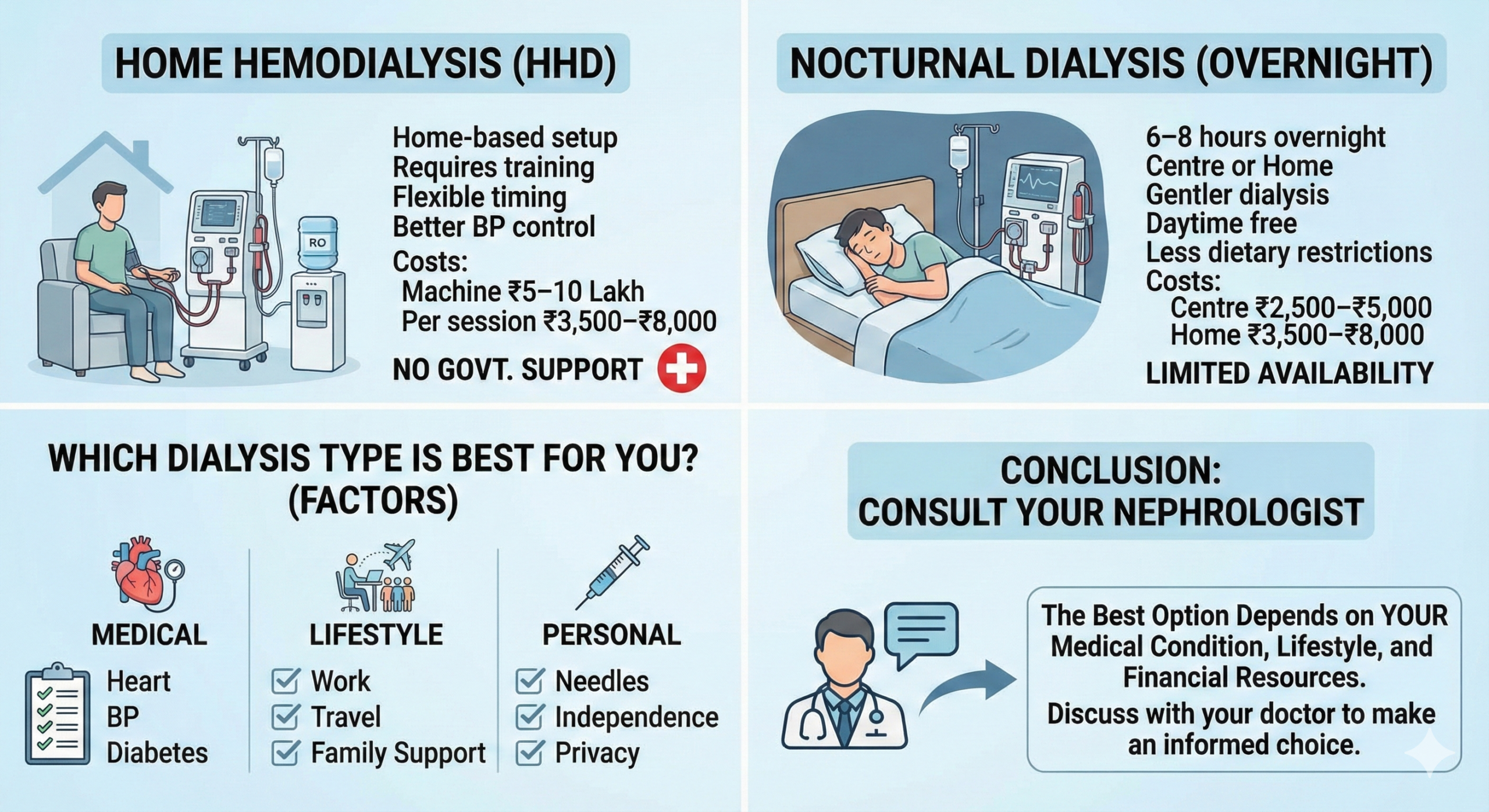
A home-based setup using a compact dialysis machine after proper training.
Who Should Choose HHD
- ✔ Young or working patients
- ✔ Those who want daily/shorter dialysis
- ✔ Remote area residents
- ✔ Patients comfortable with self-cannulation
Benefits
- More frequent dialysis → better BP control
- Flexible timing
- Better sleep, appetite & energy
- Reduced hospital visits
Limitations
- Requires training
- Requires space for machine & RO unit
- Family involvement needed
Cost & Accessibility in India
Home HD is the most expensive modality.
- Machine: ₹5–10 lakh
- RO unit: ₹60,000 – ₹1,20,000
- Per session cost: ₹3,500 – ₹8,000
- Monthly expense: Depends on frequency
Government schemes do not cover Home HD, so it remains a premium option.
- Nocturnal Dialysis (Centre-Based or Home)
What It Is
Long-duration dialysis performed overnight for 6–8 hours, either at a center or at home.
Who Should Choose It
- ✔ Patients needing gentler, slower dialysis
- ✔ Those who want daytime free
- ✔ Patients experiencing cramps, low BP, or fatigue during daytime HD
Benefits
- Longer duration → better toxin removal
- Improved sleep & BP control
- Less dietary and fluid restrictions
- More daytime energy
Limitations
- Not available in many centers
- Requires monitoring
- Home-based option requires extensive training
Cost & Accessibility in India
- Centre-based nocturnal HD: ₹2,500 – ₹5,000 per session
- Home nocturnal HD: Machine + RO + ₹3,500 – ₹8,000 per session
Availability is limited to select private centers.
Which Dialysis Type Is Best for You?
Medical Factors
- Heart condition
- Blood pressure stability
- Diabetes control
- Abdominal health
- Vascular access
Lifestyle Factors
- Work schedule
- Travel needs
- Distance from dialysis center
- Family support
Personal Preferences
- Comfort with needles
- Desire for independence
- Need for privacy
Comparison at a Glance
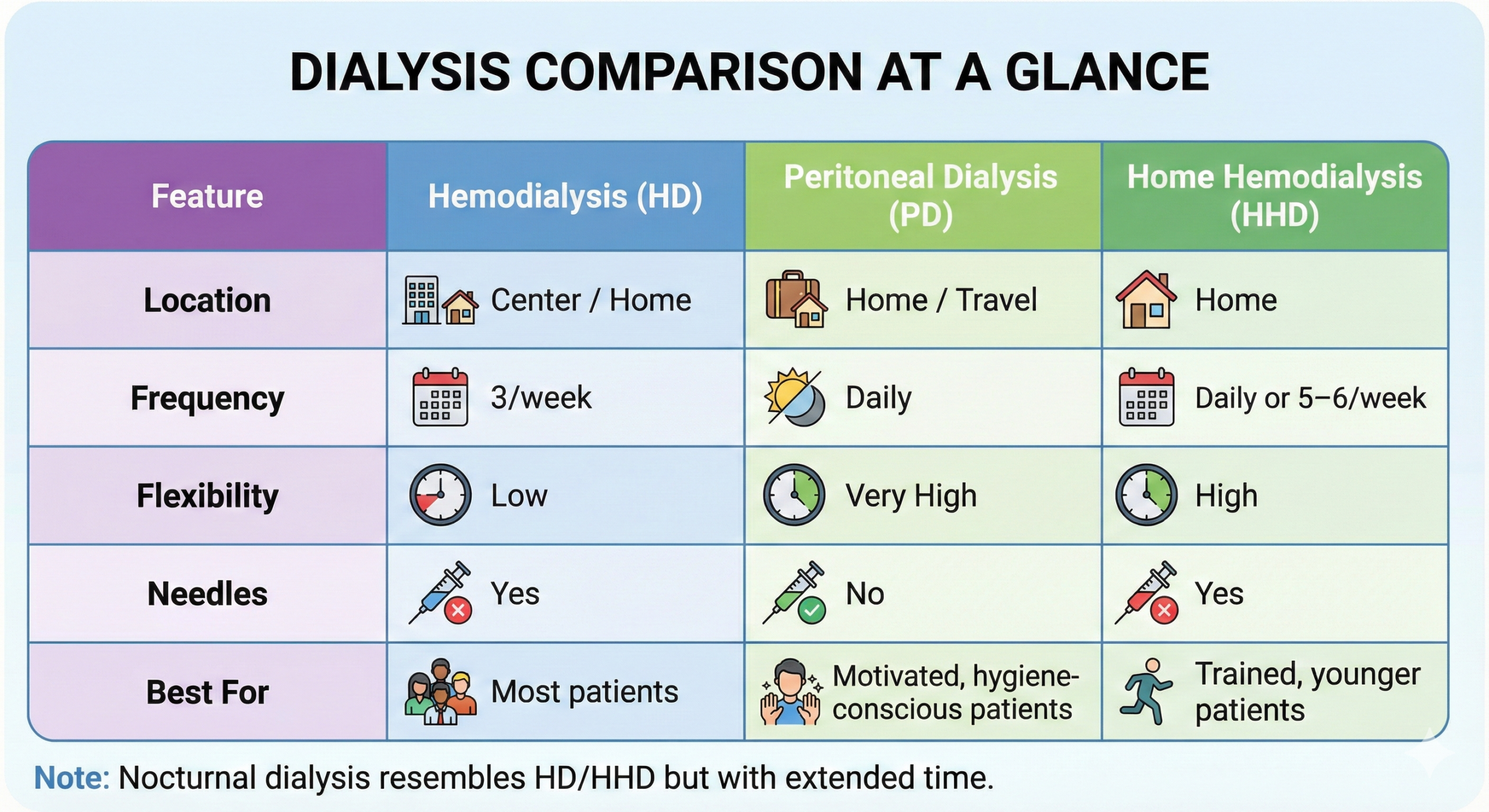
|
Feature |
Hemodialysis (HD) |
Peritoneal Dialysis (PD) |
Home Hemodialysis (HHD) |
|
Location |
Center / Home |
Home / Travel |
Home |
|
Frequency |
3/week |
Daily |
Daily or 5–6/week |
|
Flexibility |
Low |
Very High |
High |
|
Needles |
Yes |
No |
Yes |
|
Best For |
Most patients |
Motivated, hygiene-conscious patients |
Trained, younger patients |
Nocturnal dialysis resembles HD/HHD but with extended time.
Final Thoughts
There is no single “best” dialysis type.
The ideal option depends on your medical condition, lifestyle, and comfort level.
In India:
- Hemodialysis = Most accessible & affordable due to PMNDP, Ayushman Bharat & state schemes
- Peritoneal Dialysis = Best for flexibility & remote patients
- Home HD & Nocturnal HD = Best quality of life for those who can access or afford it
Always discuss with your nephrologist, dialysis technician, and family before deciding.
Dialysis Support at DCDC Kidney Care
Thousands of patients receive personalised guidance at DCDC Kidney Care to select the most suitable dialysis modality—ensuring:
- Safety
- Dignity
- Comfort
- Better quality of life